Rates & availability change: Sumba Helicopter Tours is an independent travel and concierge service that connects you to vetted drivers and partners — we are not a government body. All prices are RANGES (IDR/USD) flagged with the date last verified and separate the base service from fuel, parking, and extras; confirm current rates, vehicle, and availability before booking. Bali charges an international tourist levy of IDR 150,000 per person. If you proceed with a partner we introduce, they may pay us a referral fee at no extra cost to you.
Sumba waterfalls are wild, limestone-fed cascades framed by savannah, canyons and rice terraces in eastern Indonesia. Seen from a helicopter, Lapopu, Weekacura and Tanggedu reveal their full geometry: not just a single pool, but entire river systems and escarpments carved into the island’s heart.
Why See Sumba Waterfalls from the Air?
Most travellers first meet Sumba through long drives down single-lane roads: beautiful, but slow. From the air, the island rearranges itself. Ridges become lines; rivers become silver threads; waterfalls become punctuation marks in an otherwise golden-brown landscape.
A helicopter flight over Sumba waterfalls offers three things a road journey cannot:
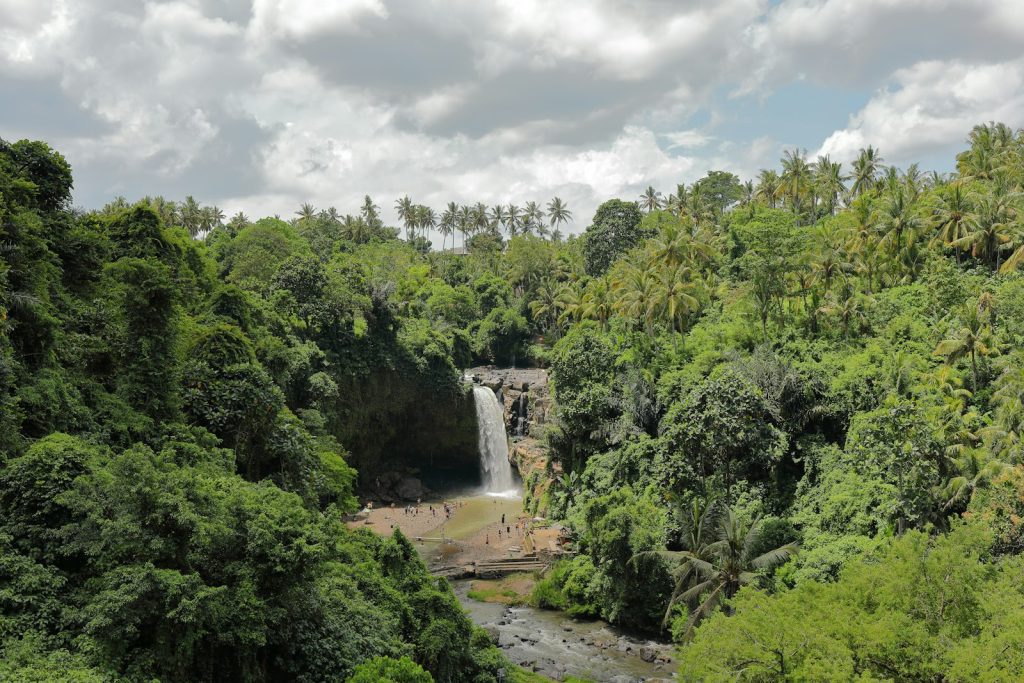
- Perspective – You see how Lapopu waterfall sits deep in the Manupeu Tanah Daru hills, how Tanggedu waterfall slices through a sandstone gorge, and how Weekacura waterfall glows turquoise beside terraced paddies.
- Efficiency – What might take 6–8 hours on mixed roads can compress into a 40–70 minute flight, with time still left for a guided landing and swim if conditions allow.
- Seasonal flexibility – In the wet season, roads can flood or turn to mud. Aircraft still face weather limits, but if clouds cooperate, the air may remain the safer, faster way to move.
Sumba Helicopter Tours is an independent private-helicopter tour and transfer service for Sumba island. We do not operate aircraft ourselves. Instead, we work with vetted operators and pilots who know Sumba’s terrain, and we design routes around what you want to see. No one can pay to change what we publish; if you proceed with our partner they may pay us a referral fee at no extra cost to you.
Orientation: Where Are Lapopu, Weekacura & Tanggedu?
The three most requested Sumba waterfalls sit in different parts of the island:
- Lapopu Waterfall
- Central Sumba, inside Manupeu Tanah Daru National Park; roughly inland from Southwest Sumba’s coasts.
- Weekacura Waterfall
- West Sumba, near Waikabubak and surrounding rice terraces.
- Tanggedu Waterfall
- East Sumba, in the Melolo / Kanatang region, within a sandstone canyon.
Most high-end travellers stay near:
- Southwest Sumba coast – beach and surf-focused resorts, private villas.
- Waingapu (East Sumba) – gateway town for flights to/from Bali and Kupang.
By road, combining Lapopu, Weekacura and Tanggedu in one day is not realistic. By helicopter, under the right weather, you can overfly all three in half a day and still decide where you wish to land and walk.
Seasonality: How Sumba Waterfalls Change Through the Year
Sumba’s climate has two broad seasons:
- Wet season (roughly December–March) – Rivers fatten, waterfalls surge, hills turn deep green. Track access may become muddy; some dirt roads are degraded or temporarily impassable after heavy rain.
- Dry season (roughly May–October) – Falls are leaner and often crystal-clear. The surrounding savannah burns gold; water levels in shallow cascades like Weekacura waterfall may drop, exposing limestone shelves.
Transitional months (April, November) can go either way, with patchy rain but often lovely conditions.
From the air:
- Lapopu waterfall in the wet season is a wide, misting curtain with several streaming tiers; in the late dry season it often becomes more sculptural, with visible stair-steps and emerald pools.
- Weekacura waterfall can range from a lively turquoise staircase to a slow, glassy series of basins that show their limestone floor clearly.
- Tanggedu waterfall is about contrast: pale blue water slicing through layered rock. In heavy wet-season flows it is powerful and foamy; in the dry season its pools can look almost painted.
Flying itself is always weather-dependent. Low cloud, heavy rain, strong winds or poor visibility can delay, re-route or cancel a heli-plan. No operator can guarantee that a particular flight will go ahead on a particular hour or day; flexibility is your friend.
Lapopu Waterfall from Above
What Lapopu Waterfall Looks Like in the Air
Lapopu waterfall is one of Sumba’s signature images: a tall, stepped cascade falling into a wide, milky-green pool, framed by dense forest. From ground level you feel dwarfed by vertical rock walls. From the air, something different appears: a long, green valley leading to the falls, with the river folding downstream toward villages and savannah.
From a helicopter, pilots typically approach along the valley, giving you:
- a first pass over dense canopy and the silver thread of the river,
- a slow orbit around the main drop and its tiers (subject to safety, airspace and wind),
- views back toward the patchwork of hills that form the western spine of Sumba.
The scale is helpful: you can see that Lapopu is not a single vertical drop but a multi-step waterfall, with shelves and smaller cascades above the main height.
Best Time of Year for Lapopu Waterfall
For aerial views:
- December–March: dramatic, high-volume flow; mist may partially veil details; expect deeper greens.
- May–July: a strong compromise—ample water, but usually clearer air, less mist, and good definition of the tiers.
- September–October: more sculptural and gentle; ideal if you value clarity of rock formations over raw power.
Landing vs Overflying Lapopu
Helicopter landings near Lapopu waterfall are tightly constrained by terrain, park rules and safety. In practice:
- Overflight-only experiences are common: you see the falls from several angles, then continue along the ridge-lines or toward other sites.
- Landing & hike combinations may be possible depending on the operator, aircraft type, park permissions and current ground conditions. The standard trekking trail involves a mix of dirt path and simple river-crossing.
If you want to prioritise a landing near Lapopu, tell us early in your planning. We’ll check what’s realistic with current rules and the specific operator and pilot assigned to your date.
Weekacura Waterfall from Above
The Aerial Geometry of Weekacura
Weekacura waterfall is more about pattern than height. Instead of a single big drop, you see a series of turquoise basins carved into pale rock, fed by a low cascade. From above, it looks almost like a natural infinity pool system spilling gently downstream.
On approach, the helicopter reveals:
- Rice terraces and small fields surrounding the river, often bright green in the wet and early dry season.
- Village life – smoke from kitchens, footpaths, sometimes children walking along the track to the falls.
- The cascade itself – a shallow drop into stepped pools; sunlight gives them a soft aqua glow on clear days.
Weekacura waterfall is particularly photogenic when sunlight is high enough to illuminate the pools but not so harsh as to blow out the highlights—late morning or mid-afternoon can work well, depending on your route.
Seasonal Character
- Wet season: higher water levels, stronger flow, sometimes a more opaque turquoise tone.
- Dry season: shallower water; the terraces of limestone show through, creating intricate textures from the air.
Because Weekacura sits in a relatively open valley, it usually reads clearly from helicopter altitude, even when water levels are modest.
Combining Weekacura with Lapopu
By road, visiting both Lapopu waterfall and Weekacura waterfall in a single day from West Sumba involves several hours of driving, some of it slow. By helicopter, an arc that sweeps from coast to interior can give you both in one continuous narrative:
- Depart from a coastal helipad or airstrip.
- Follow the savannah ridges inland until the land folds into hills.
- Overfly Weekacura and its rice terraces.
- Continue deeper into the national-park hills for a circuit around Lapopu.
Each route is customised to your time-window, weight and safety limits, and current weather. To explore possible arcs, you can plan your trip with our team via form or WhatsApp; we’ll map realistic options around your dates.
Tanggedu Waterfall from Above
Why Tanggedu is Different
Tanggedu waterfall lies in East Sumba and feels almost like a different island. The landscape shifts from rolling hills to eroded canyons, with water cutting deep channels through layered stone.
From the air, Tanggedu waterfall resembles a pale, sculpted throat of rock with aqua water curling through it. Key aerial impressions:
- The canyon – narrow, with high, striated walls in shades of beige and grey.
- Steps and slides – water rushing over smooth rock, forming natural slides and bowls.
- Surrounding savannah – especially in the dry season, a honey-colored expanse, making the water’s colour stand out dramatically.
Tanggedu’s true shape is difficult to grasp from ground level because you move along the river. From above, the whole gorge opens; you see how the falls and slides are distributed along a sinuous corridor.
Best Conditions for Viewing Tanggedu from the Air
- Late dry season: softer, inviting pools; more visible rock detail.
- End of the wet season: stronger flow, bolder whitewater contrasts against the canyon.
In very heavy rain, the canyon can turn turbulent and muddy; flights may be restricted or re-routed for safety or visibility reasons.
Pairing Tanggedu with East Sumba Highlights
Aerial routes around Tanggedu waterfall can also skim:
- Coastal cliffs and beaches east of Waingapu, with long arcs of surf and minimal development.
- Traditional hilltop villages with megalithic tombs and peaked thatched roofs visible from above.
- Interior savannah where horse herds sometimes graze (sightings are never guaranteed).
Such a circuit can work nicely on arrival or departure days if you are already transiting through Waingapu’s airport and want to slip a waterfall flight into the schedule.
Helicopter vs Road: How Experiences Compare
Below is a simplified comparison between helicopter-focused and road-focused ways of experiencing Lapopu, Weekacura and Tanggedu waterfall. These are indicative only and based on commonly booked patterns.
| Aspect | Helicopter-Focused | Road-Focused |
|---|---|---|
| Time Efficiency | Multiple waterfalls in 0.5–1 day of flight time. | Typically one major waterfall per long day. |
| Perspective | Full landscape context; ideal for photography and orientation. | Immersive ground feel but limited sense of overall geography. |
| Physical Effort | Minimal walking unless a landing and hike is added. | Moderate to significant hikes; uneven trails and river-crossings. |
| Comfort | Smooth, cool cabin; no dust or potholes, but some rotor noise and vibration. | Heat, dust and variable road quality; private vehicles can be comfortable. |
| Weather Exposure | Flights may delay or cancel in poor weather. | Road access may be reduced by heavy rain, mud or river conditions. |
| Cost Level | Higher per hour; often best shared by families or small groups. | Lower; fuel and driver/guide fees spread over the day. |
Many guests choose a hybrid approach: one or two days of helicopter arcs to place remote landscapes in context, then slower ground days to linger at specific sites.
Indicative Helicopter Routes & Pricing for Sumba Waterfalls
All helicopter prices on this page are indicative ranges only, last verified June 2026 from the broader Indonesia charter market, not Sumba-published rates. Final quotes depend on aircraft type, fuel, routing, weight, landing permissions and operator availability, and must be confirmed by the actual operator on your dates.
As a rough guide for Sumba waterfalls-focused flights:
- Short scenic flight (approx. 20–30 minutes air time)
Example: coastal departure, quick inland loop over one main feature (e.g., Lapopu waterfall), no remote landing.
Typical private charter range (last verified June 2026): around USD 2,000–3,000 total per helicopter. - Half-day waterfall circuit (approx. 45–75 minutes air time, possibly split into legs)
Example: overfly Lapopu waterfall + Weekacura waterfall from a Southwest Sumba base, or Tanggedu waterfall from East Sumba, with potential landing time elsewhere for photos or a short walk if conditions, permissions and fuel planning permit.
Typical private charter range (last verified June 2026): around USD 3,000–6,000 total per helicopter. - Full-day custom itinerary (multiple sectors, 90+ minutes air time)
Example: cross-island route incorporating Lapopu, Weekacura and Tanggedu in one day, possibly linking two different accommodations or airports, with strategic landings arranged in advance.
Typical private charter range (last verified June 2026): around USD 6,000–10,000+ total per helicopter.
These ballpark figures assume a light to mid-size helicopter typical of remote Indonesian charter operations, with 3–5 passenger seats depending on weight. Actual capacity, luggage allowance and routing must be confirmed case-by-case.
For custom pricing discussions tailored to your party size, luggage and schedule, you can plan your trip with us; we’ll continue the details via WhatsApp or your preferred channel.
Designing Your Sumba Waterfalls Flight
Clarify Your Priorities
Before we speak with operators, it helps to know your priorities:
- Photography or simple sightseeing? Photographers often prefer more orbiting time around each waterfall, with attention to sun angle and haze; this may mean fewer total sites.
- Overflight only or landings as well? Landings add richness but also complexity: permissions, safety assessments, fuel calculations and sometimes higher cost.
- One-way transfer or loop? Helicopters can be used to reposition you between resorts or to/from the airport while integrating waterfall flyovers.
Timing in the Day
Light in Sumba is strong and directional. Early and late in the day, shadows give waterfalls and canyons definition. Midday offers stronger light into turquoise pools but can flatten the savannah.
Some patterns that often work well (subject to aircraft schedule and your base):
- Morning: inland hills and Lapopu waterfall, when air is often cooler and less turbulent.
- Late morning to early afternoon: Weekacura waterfall and rice terraces; turquoise can pop under a higher sun.
- Mid-afternoon: Tanggedu waterfall and east-coast canyons, with warm side-light on the cliffs.
These are preferences, not promises. Cloud patterns, haze, and operational windows on your actual date will shape the timetable.
Weather & Contingencies
Flying is always subject to:
- Visibility and cloud ceiling around Sumba’s hills.
- Wind strength, especially across ridges and coastal cliffs.
- Rain cells that can quickly form in the wet season.
Pilots and operators make the final call on safety. That may mean:
- Adjusting your route (e.g., prioritising coastal sections if interior clouds build).
- Delaying departure to wait for conditions to improve.
- Cancelling if conditions do not meet safety thresholds.
We can discuss contingency ideas in advance—alternate days, alternate timing, or road-based back-up plans—so you still have meaningful experiences if the sky does not cooperate.
Practical Tips for Luxury Travellers
What to Wear & Bring
- Clothing: Light, breathable fabrics; avoid wide-brimmed hats or loose scarves that can be problematic around rotors.
- Footwear: Closed shoes with good grip if landings and short walks are planned (some waterfall trails involve rocks and occasional mud).
- Photography gear: Camera with image stabilisation if possible; wide-angle for landscapes and moderate telephoto for details. Polarising filters can help with glare on water but require care around aircraft windows. Keep gear compact—space is limited.
- Water & sun protection: Sunscreen, sunglasses; the cabin protects you from direct wind but not from tropical light once you step out.
Health & Safety Considerations
- Motion and vertigo: If you are sensitive to motion, let us know; smoother routing and seat choice can sometimes help.
- Noise: Headsets will be provided by the operator; they protect your hearing and allow communication with the pilot.
- Weight & balance: Accurate passenger and luggage weights are critical for safe helicopter operations. Expect operators to ask for these in advance.
Sumba’s waterfalls and canyons are wild spaces, not theme parks. On any ground segment, paths may be uneven, rocks can be slippery and there are usually no guardrails. Good guides and sensible footwear go a long way.
Why Plan Through Sumba Helicopter Tours
We are a specialised, independent concierge for helicopter touring and transfers on Sumba. Our role is to:
- Listen to how you like to travel and what you want to see—from Lapopu waterfall to remote savannah ridges.
- Match that wish-list with vetted helicopter operators, pilots and ground teams currently active around Sumba.
- Provide context on seasons, realistic timing and what can or cannot sensibly be done in a day.
We are not an aviation authority, a government body, or a resort. No one can pay to change what we publish; if you proceed with our partner they may pay us a referral fee at no extra cost to you.
If you are ready to sketch your own aerial map of Sumba waterfalls—Lapopu curtain, Weekacura terraces, Tanggedu canyon—you can plan your trip. Share a rough date range, number of travellers and where you expect to stay; we’ll follow up, often via WhatsApp, with route ideas and indicative budgets.
FAQ: Sumba Waterfalls by Helicopter
Can I visit Lapopu, Weekacura and Tanggedu waterfall all in one helicopter day?
Under good weather, with an appropriate aircraft and careful routing, it can be possible to overfly all three Sumba waterfalls in a single full-day helicopter itinerary. The exact feasibility depends on your starting point, weight, fuel planning and daylight. Frequently, guests choose to focus on two of the three for more orbit time and photography, then add the third on a transfer day or via road with a local guide.
Are landings at the waterfalls guaranteed?
No. Landings depend on terrain, permissions, safety assessments and current conditions on the day of flight. Some Sumba waterfalls, such as Lapopu waterfall inside a national park, have more constraints. In many cases, operators will offer overflights only, or landings at safer nearby clearings rather than right beside the cascade. Treat any landing as an intention rather than an absolute guarantee.
How far in advance should I book a helicopter tour over Sumba waterfalls?
For peak months and large groups, starting the conversation 2–3 months in advance is sensible, especially if you have fixed international flights or resort dates. Helicopters are limited in number on Sumba and often reposition from other islands. Shorter-notice requests can sometimes be accommodated, but flexibility on exact date, time and routing is very helpful.
Is a helicopter flight safe during the wet season in Sumba?
Helicopter operators will not fly if conditions do not meet their safety standards, regardless of season. During the wet months, rain cells, low cloud and changing winds are more frequent, so delays, re-routing or cancellations are more common. If your schedule has buffer days and you are comfortable with this uncertainty, the wet season can reward you with powerful river flows and lush surroundings.
Can families with children do helicopter flights over Sumba waterfalls?
In many cases, yes, provided children meet the minimum age and seating requirements of the specific operator and can comfortably wear a headset and remain seated with a belt on. Some operators set their own age guidelines. If you are travelling with young children, share their ages and approximate weights at the enquiry stage so we can approach suitable partners and design an itinerary that feels relaxed rather than rushed.